
A Week at Sri Ram Ashram
Where love becomes structure and service becomes home
There are journeys that change the landscape outside you, and there are journeys that rearrange the interior of your heart. A week in Shyampur, in the Haridwar district, at the edge of Elephant Village and within walking distance of Mother Ganga, would do both for me.
I arrive at Sri Ram Ashram just before 9:00 in the evening during the sacred week of Shivaratri. Kirtan (devotional singing) from the Kanwar Yatra grounds echo faintly in the distance. At the gate stand Seema, Narayan, Nutan, and Madhu, waiting. There is a particular tenderness in being awaited. It sets the tone for what this place truly is: a space where presence is not assumed, but offered.
Though I have already eaten, a glass of warm milk is pressed into my hands. Thick, creamy, impossibly fresh. It tastes like care. It’s my first lesson in ashram hospitality: nourishment is not merely nutritional; it is relational.
That night, I go to bed knowing that the days ahead will unfold in rhythm — pranayama (breathing techniques) at dawn, shared breakfasts, study time, play time, arati (ritual of light) at dusk, simple dinners, and early rest. The structure is gentle yet steady. It does not constrain; it contains. In a world that often fractures attention and disperses care, this environment offers safety and stability. Through daily devotion, it quietly interrupts cycles of abandonment and neglect.
Dawn and Discipline
Before the campus begins to stir the following morning, I walk alone to the Ganga for my regular sadhana (spiritual practice). The path winds through mustard fields and village lanes, the air cool and still. By the river, I practise pranayama and asana (postures) as the sun rises slowly over the water.
There is something deeply grounding about bowing to the river alone, aware that Baba Hari Dass once walked similar soils. His life embodied disciplined compassion, silence expressed through service. It was this spirit that inspired the founding of the ashram in Shyampur. His instruction to “meditate every day” no longer feels like guidance from afar; it feels like a living thread connecting California, Salt Spring Island, and this rural corner of Uttarakhand.
When I return, the campus is fully awake.
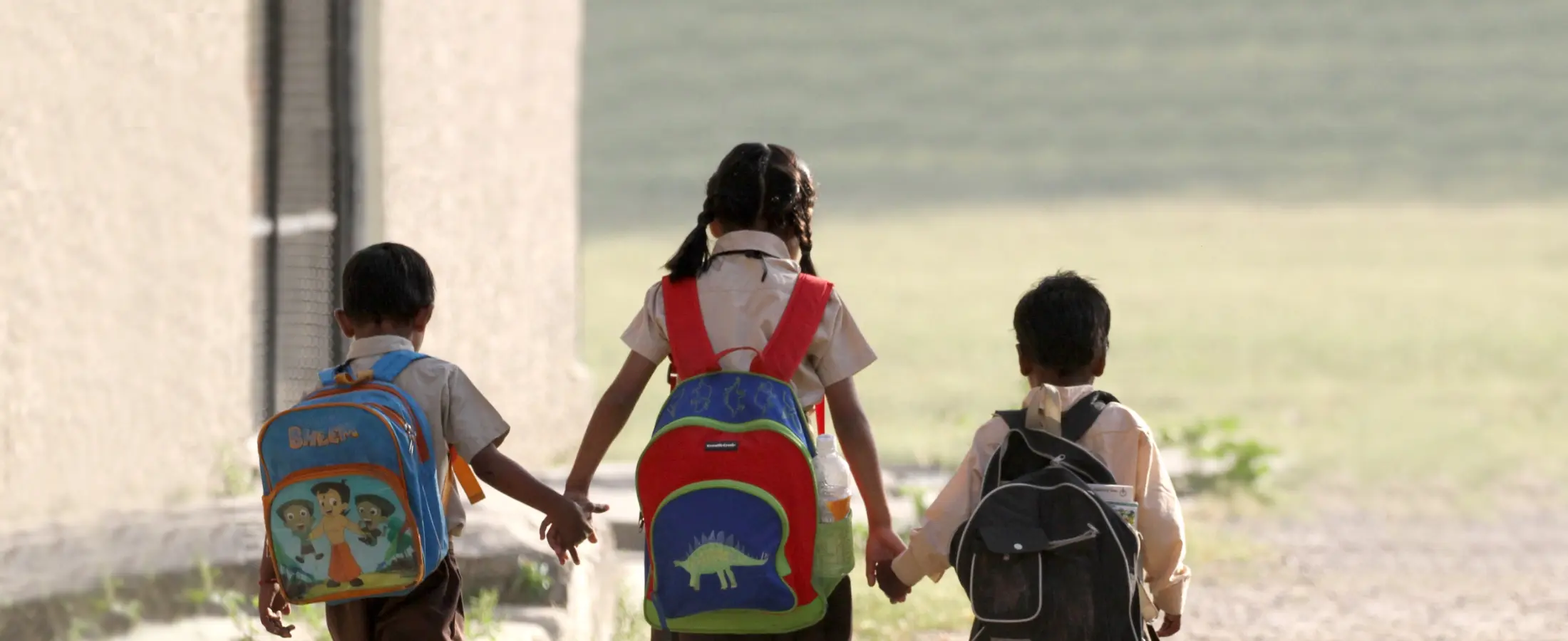
Children in neat uniforms, hair oiled and braided, gather for assembly. The “mummies,” as the caregivers are lovingly called, move with quiet efficiency. Older children help the younger ones button shirts and tie shoelaces. Attendance is called. “Good mornings” are exchanged with clarity and confidence.
Some of these children were delivered by the police, rescued from abandonment, trafficking networks, or life on the streets. Today, they stand upright, reciting prayers and lessons.
There are forty-two children at the ashram now. Yet this is more than a residence; it is an ecosystem. A dining hall serves fresh seasonal meals, rajma, chana dal, dahi, rice, roti, sabzi, and kadi, with remarkable consistency and dedication. There are dormitories, study halls, a computer lab, playgrounds, and a goshala. Mango trees and rose beds line open courtyards where younger children sit after their oil baths, soaking in the winter sun.
The little ones below seven are bathed and cared for by the mummies, who serve as primary guardians. They are held, oiled, braided, and comforted. The older children assist the younger with dressing, eating, and studying. At the ashram, siblings are defined not by blood but by bond.
At noon, the bell rings. Plates are filled. Hands fold in gratitude. The food is simple and nourishing. Consistency, I learned, is a form of love.
Education as Liberation
During my visit to Shri Ram Vidya Mandir (SRVM), I begin to understand something that moves me deeply.
Rajiv sir explains that the school was founded not merely because higher education was geographically distant, but because many of the children had learning curves and emotional needs that government schools could not accommodate. Trauma does not disappear once a child is rescued. It lingers in attention spans, behavior, and confidence. Overcrowded classrooms were not designed for such realities.
So the community built its own school.
Established in 1992, SRVM began in modest partitioned rooms. Today, it serves hundreds of students from surrounding villages. Buses travel rural roads. Science streams are offered. Classrooms are structured yet responsive. At its heart, the school remains attentive to children who require patience, flexibility, and individual care.
I conduct a workshop on menstrual health management for girls in grades 7, 8, 9, and 11. They ask thoughtful and unembarrassed questions. Their confidence is not imposed; it has been cultivated over years of being heard.
Many graduates have gone on to universities, national hockey teams, professions, and family enterprises. Several are first-generation literate. Many return to give back, to visit, to remember where they first learned to read, speak, and dream.
At SRVM, education bends where necessary. It does not break the child to fit the system.
The People Who Hold the Ashram
No institution survives on vision alone; it survives on people.
Andrea Kumar’s journey began in Germany. At thirteen, she met Baba Hari Dass in Salt Spring, British Columbia. At eighteen, she travelled to Haridwar and, in many ways, never truly left. Today she lives within walking distance of the ashram with her husband and two daughters, now in grades 10 and 12.
Andrea ji has been a quiet yet powerful force behind the ashram’s development. From overseeing medical care and nursing to establishing structured adoption processes, her presence has shaped the systems that protect the children. She bridges continents with calm efficiency, ensuring that no child’s well-being is left to chance.
Seema ji, the beloved warden, oversees everything from arati and homework to managing visiting guests. When asked her favorite part of the job, she simply says, “Everything.” It is neither exaggeration nor sentiment; it is devotion.
Sarada Diffenbaugh first visited Haridwar when she was around my age, 25. Now in her seventies, she brings decades of educational leadership and unwavering commitment to the teachings she has followed for a lifetime. Her husband, Dayanand Diffenbaugh, has stewarded the land and infrastructure with thoughtful care, reflecting his deep study of the Yoga Sutras.
Rajiv and Rima Bhalla bring warmth and grounded practicality to daily operations. They know the children personally and ensure that vision translates into functioning reality.
In the kitchen, Anil Yadav and Param Singh begin their work at 5:00 each morning. Chai is brewed. Breakfast is prepared. Meals continue until dinner. The aroma of roti and dal fills the air. Meals become shared labor and shared joy.
Bachendra Sharan arrived at the ashram as a child in 1992. Today, he manages the office and finances. Holding a BA and having taught himself accounting, he smiles easily behind his desk. The child who once needed care now safeguards the institution that raised him.
This is generational transformation.
Evenings of Song and Story
As dusk settles, children scatter across the playground — football, cricket, running races. Laughter rises freely. After tea and evening study, everyone gathers for arati. Lamps are lit. Voices rise together in bhajan (devotional singing). The founder’s teachings are not distant ideals; they are woven into daily practice.
On my final evening, I celebrate my birthday by sharing pizza with the children. Their unfiltered joy makes the simplest gathering radiant.
The same day, a new child arrives.
She wears worn clothes that carry the weight of her journey. The other children gather around her not with intrusive curiosity, but with recognition. She is given a warm bath, fresh clothes, oil gently massaged into her hair. A medical check-up is arranged. A caregiver assigned. She is enfolded into the circle.
The next afternoon, she tugs lightly at my sleeve.
“Didi, jhula me chalte hai?”
“Sister, can we play on the swing?”
It is a small request. Yet it reveals something profound.
Within twenty-four hours of arrival, her instinct is not fear, it is play.
We walk to the swings. She laughs, first hesitantly, then freely, pumping her legs higher and higher. In that moment, suspended between earth and sky, she is simply a child on a swing.
A Tale of Two Indias
On my flight back to Bangalore, I sit among students from an elite international school — confident, global, technologically fluent. I recognise that ease; I grew up with similar opportunities. Their lives are shaped by access and advantage. The children I just left are shaped by resilience.
India contains both realities.
But the measure of a society is not how high its privileged children fly but how carefully it lifts those who begin without wings.
Every child longs for belonging.
At the ashram, that longing is met with structure, education, affection, and dignity. There is no romanticising of poverty, no dramatizing of suffering, only the quiet, daily work of raising forty-two children into stable adulthood.
An Invitation
To the well-wishers of Mount Madonna, the Salt Spring Centre of Yoga community, and those who cherish these teachings: your support is tangible.
It is braided into a seven-year-old’s hair.
It is ladled into a bowl of dal.
It is printed in textbooks and written across blackboards.
It is the bus that carries a village child to science class.
It is the oil that warms a child’s scalp in winter.
If you have ever wondered what your seva (selfless service) sustains, come and see.
Walk to the Ganga at dawn.
Sit in the dining hall.
Listen to stories.
Help with homework.
Play football at dusk.
Witness how Yoga becomes administration, how devotion becomes governance, how love becomes infrastructure.
Beyond this place, allow your heart to widen further. Across India and the world, childcare homes labor with limited resources. They not only require funds, but thoughtful partnership and sustained commitment. When we support such institutions responsibly, we participate in a global act of restoration.
In the Yoga Sutras, the movement toward non-duality begins with right relationship — ahimsa (non-harming), satya (truthfulness), asteya (non-stealing), brahmacharya (moderation), aparigraha (non-possessiveness). At the ashram, these principles are practised not in theory but in daily routine.
I leave with a fresh perspective and an open heart.
If this story moves you, follow that movement.
Sometimes the deepest spiritual lesson is found in answering a small voice that asks,
“Didi, jhula me chalte hai?”
“Sister, can we play on the swing?”
→ Follow the movement and begin your journey with Yoga Diwali India: A Cultural Immersion